

Concrete Barriers vs W-Beam Steel Road Barriers: A Comparative Analysis for SA Roads
Although both the concrete barrier and W-beam steel safety barriers deserve a place in road safety excellence for saving lives on our roads, there are differences in their usability, functionality, and logistical manoeuvrability. Today, the experts at Armco Superlite will investigate the comparisons and explain both barriers’ rules and regulations on the road.
At Armco Superlite, we have earned our reputation through decades of engineering expertise, manufacturing precision, and a focus on impact resistance, making our steel solutions a preferred option across national and regional road networks throughout southern Africa.
Concrete Barrier and W-Beam Safety Barriers: Purpose and Design
The concrete barrier is commonly selected for median separation, high-traffic urban routes, and areas demanding rigid containment. Its mass and rigidity provide predictable vehicle redirection, especially in narrow corridors. Inversely, W-beam safety barriers, manufactured by Armco Superlite, rely on controlled deformation. This design absorbs kinetic energy, reducing forces transferred to vehicle occupants while guiding vehicles back toward the carriageway.
This difference characterises much of the steel vs. concrete discussion. Concrete barriers secure containment, while W-beam systems focus on energy absorption and controlled redirection, a vital factor in occupant safety.
Material Durability and Long-Term Performance
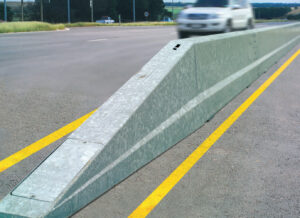
image description
Concrete barriers are valued for longevity and resistance to fire, corrosion, and weathering. Precast barriers offer consistency and rapid placement, especially in regions with heavy traffic volumes. Concrete barriers in SA often appear on bridges, toll plazas, and construction zones where permanence matters.
Our W-beam steel road safety barriers deliver durability through high-grade steel combined with precision manufacturing. Steel components respond well under repeated impact events, maintaining structural performance with targeted repair rather than full replacement. Over long service lives, this characteristic influences lifecycle cost and road availability.
Applications Across Southern African Roads
Concrete solutions are best for locations requiring minimal deflection, such as elevated structures and narrow medians. Their rigidity proves useful where road geometry restricts barrier movement.
Alternatively, W-beam steel systems suit highways, rural roads, interchanges, and roadside hazards. Our products meet different installation requirements, offering adaptable layouts without complex civil works. This versatility explains widespread adoption across SANRAL routes and municipal networks.
Transport, Installation, and Handling
Precast barriers involve heavy logistics, cranes, and reinforced foundations. Transport to the site involves specialised vehicles, contributing to higher logistical planning demands.
Steel W-beam systems present lighter components, simpler handling, and efficient installation. Our barriers arrive ready for assembly, reducing equipment needs and installation time. These efficiencies improve project scheduling and traffic management during road works.
Cost and Maintenance Considerations
Initial costs for concrete barriers can appear competitive, particularly in large-scale projects. However, over time, repair after impact often requires barrier replacement, lane closures, and heavy machinery.
Inversely, steel systems excel in maintenance efficiency. Damaged W-beam sections can be replaced individually, limiting disruption. This maintenance model influences long-term budgets and network availability, which is an important factor in steel vs concrete evaluations.
Safety and Impact Resistance
Impact resistance is always a deciding factor in barrier selection. Concrete barriers redirect vehicles abruptly, which fits certain high-risk zones. However, this rigidity can increase deceleration forces.
W-beam steel road safety barriers manage impact energy through deformation, lowering injury risk. This controlled response aligns with modern road safety standards, prioritising occupant protection together with containment.
Plain and Galvanised Steel Excellence
At Armco Superlite, our W-beam barriers are available in plain or galvanized steel. The galvanization process involves a hot-dip coating that forms a metallurgically bonded zinc layer. This coating protects steel against corrosion, extending service life even in coastal environments.
A Balanced View With a Trusted Partner
Concrete solutions will always be essential in certain road safety scenarios, particularly in dense urban corridors and permanent installations. Even so, Armco Superlite W-beam systems deliver measurable advantages in safety performance, maintenance efficiency, and installation practicality. When comparing options, each concrete barrier application benefits through careful assessment alongside advanced steel alternatives.
At Armco Superlite, decades of experience in road safety products guide every recommendation. We assist road authorities, civil engineers, and contractors in designing perfect barriers. So, consult us for premium road safety products designed to protect lives and infrastructure across southern Africa.